Why Did the Chicken Block the Kei Truck?
Why Did the Chicken Block the Kei Truck?
A short story on tariffs, regulations, and decades-old decisions still affecting what you can buy today
You can buy a kei vehicle in the United States. Technically.
Only if it is 25 years or older. Only in states that still allow registration — and that list is shrinking, with Rhode Island denying new registrations since 2021 and Georgia revoking titles it previously issued under a 2023 policy bulletin. And only after paying a 25% import tariff that has been in continuous effect since 1964, originally imposed in retaliation for European tariffs on American chicken.
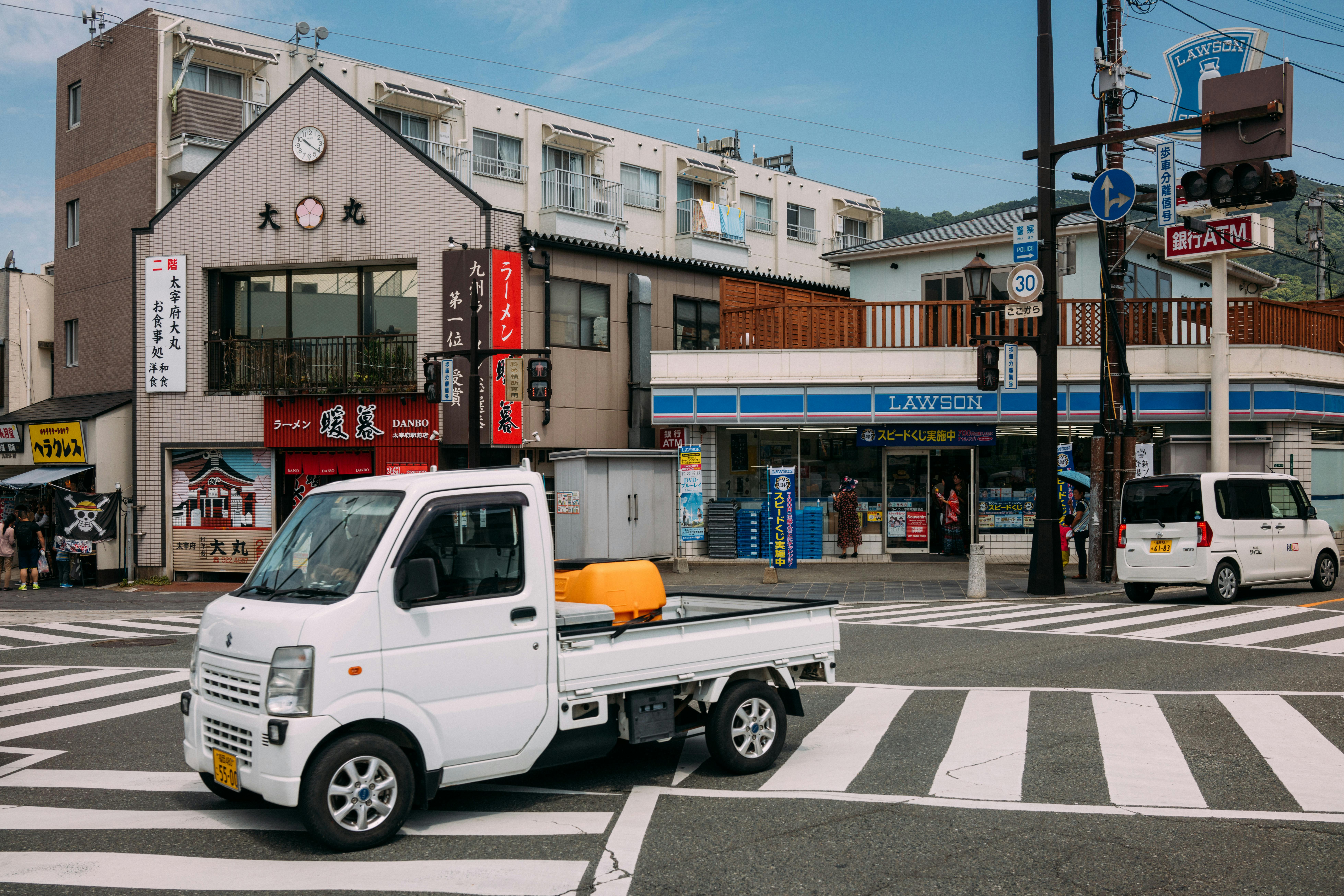
Kei vehicles are Japanese mini utility vans, trucks, and SUVs. They get around 30 to 40 miles per gallon in real-world US driving. New ones sell in Japan for $9,000 to $13,000. The average new vehicle in the United States costs approximately $49,500. Americans who know about kei vehicles want them badly. Enthusiast communities, farmers, ranchers, and contractors have spent years finding workarounds to import 1990s-era models, fight state registration battles, and navigate a regulatory patchwork that no single person designed and no one has ever been tasked with fixing.
The story of why you cannot buy a new kei vehicle in the United States is not really a story about kei trucks. It is a story about what happens when three separate laws, written across six decades for three completely unrelated reasons, compound each other without anyone noticing — and what that pattern means for every industry that operates in the shadow of government decisions.
TL;DR
- Three laws built the wall. The Chicken Tax (1964), CAFE fuel economy standards (1975), and the FMVSS 25-year exemption each addressed a different crisis. None was written with the others in mind. Together they produce an outcome nobody designed: only the oldest, dirtiest kei vehicles are legal to import, while the newer, cleaner ones stay blocked.
- The tariff applies directly. A 2024 CBP ruling confirmed that kei vehicles are classified as light trucks under tariff code 8704.31.0120, subject to the full 25% Chicken Tax rate.
- Trump's fix addresses one of three problems. His December 2025 directive on domestic kei vehicle production does not touch the tariff, the state registration patchwork, or the 60 years of market economics that made small vehicles financially irrational for Detroit to build. No rulemaking has been filed as of mid-2026.
- This is not a kei truck story. Every industry with meaningful government exposure has a version of this: multiple rules written by different agencies at different times, never reviewed as a system, producing outcomes that affect everyday decisions in ways nobody tracks.
The Chicken Tax (1964): A Trade Dispute That Never Ended
After World War II, American factory farming industrialized at a scale the rest of the world had not yet achieved. By the late 1950s, US poultry producers were exporting enormous quantities of cheap chicken to Europe, undercutting local farmers on price. France and West Germany responded with tariffs on American poultry imports. By 1962, the United States had lost nearly a quarter of its European chicken sales, amounting to roughly $261 million in today's dollars.
The Kennedy and Johnson administrations pushed back. Negotiations failed. In December 1963, President Johnson signed Proclamation 3564, imposing retaliatory tariffs on a list of European goods including brandy, dextrin, potato starch, and light trucks. The order took effect January 7, 1964.
The connection between chicken and light trucks was not agricultural. It was political. Volkswagen's Type 2 van was at the time outselling Detroit in the US market — offering better cargo space and nearly double the fuel economy of comparable American vehicles. US automakers and UAW president Walter Reuther saw an opportunity in the trade dispute. Reuther offered President Johnson a deal: union support for the Civil Rights Act in exchange for including light trucks in the retaliatory tariff. Johnson agreed. Proclamation 3564 was signed on December 4, 1963, six months before Johnson signed the Civil Rights Act into law.
The brandy and potato starch tariffs were eventually dropped. The truck tariff never was. Europe resolved the chicken dispute. The United States kept the truck tariff anyway. A Cato Institute study published in 2003 called it "a policy in search of a rationale." It remains in effect today, 61 years after it was signed.
Japanese manufacturers immediately tried to work around it. They shipped kei trucks to the United States without the truck bed, attached the bed on US soil, and avoided the tariff classification entirely. In 1964 alone, foreign truck imports fell by two-thirds after the tariff took effect. US Customs closed the bed-attachment loophole in 1980. Since then, kei vehicles imported for road use have faced the full 25% tariff — confirmed by a 2024 CBP ruling classifying a 2023 Daihatsu HiJet under tariff code 8704.31.0120, the light truck tariff code, at 25%.
A kei van weighs under 1,500 pounds. CBP still calls it a light truck.
CAFE (1975): A Fuel Economy Law That Made Everything Bigger
Eleven years after the Chicken Tax, the 1973 Arab oil embargo created a different crisis. Gasoline shortages and price spikes exposed how dependent the United States had become on imported oil and how fuel-inefficient its vehicle fleet was. Congress passed the Corporate Average Fuel Economy standards in 1975 as part of the Energy Policy and Conservation Act, requiring automakers to meet fleet-average fuel economy targets across everything they sold.
In implementing CAFE, Congress divided vehicles into two categories: passenger cars and light trucks. Light trucks received a meaningfully lower fuel economy standard than passenger cars — a distinction that made legislative sense at the time, when light trucks were genuinely work vehicles used by farmers and contractors, not the dominant consumer product they would become.
Nobody in 1975 cross-referenced this decision with the 1964 Chicken Tax. Nobody noted that Detroit already had eleven years of protected dominance in the light truck segment, with no meaningful foreign competition, because the tariff had eliminated it. The CAFE light truck carve-out did not create that protection — it compounded it. Lower regulatory standards plus no import competition meant one rational strategic direction for American automakers: go bigger, build more trucks, capture higher margins.
The Big Three specialized almost entirely in trucks over the following decades. Harvard professor of international trade Robert Lawrence later documented that this specialization left the Big Three structurally unable to respond when gas prices spiked — they had spent decades building a business model that only worked when trucks were cheap to operate. The American consumer preference for large trucks and SUVs, often described as organic demand, was substantially shaped by a tariff on chicken and a fuel economy standard that treated trucks as a separate and less demanding regulatory category. Neither law was written to produce the American truck market. Together, that is what they produced.
The result for kei vehicles was total market foreclosure. By the time Japanese manufacturers might have considered engineering kei vehicles to US standards, the economics of the US light truck market had been structured by 30 years of compounding policy to make small, efficient vehicles financially irrational to sell here. The margin structure, consumer expectations, and dealer network were all built around full-size trucks. Kei vehicles had no path in.
The 25-Year Rule: A Safety Exemption That Accidentally Bans the Cleaner Vehicles
Federal Motor Vehicle Safety Standards require all new vehicles sold in the United States to meet crash test requirements designed for American road conditions — speeds up to 80 miles per hour, roads shared with full-size trucks and SUVs that weigh several times what a kei vehicle does. Kei vehicles were engineered for Japan's roads, where highway speed limits top out at approximately 62 miles per hour and the surrounding vehicles are much smaller. They were never designed to meet FMVSS crash standards, and retrofitting them to do so would cost more than the vehicles are worth.
There is one exception: vehicles 25 years or older are exempt from FMVSS compliance requirements under NHTSA regulations. This exemption exists for historical and collector vehicles — cars old enough that requiring them to meet modern safety standards would effectively ban them from the road entirely. The exemption was not designed with kei trucks in mind. But it is the only legal pathway for kei vehicles to enter the US market, which is why every kei vehicle legally operating on US roads is a 1990s model.
Here is where the unintended consequence appears. Japan significantly tightened vehicle emissions standards for kei vehicles in the early 2000s, adopting new test cycles and emission limits that made modern kei vehicles substantially cleaner than their 1990s predecessors. The 2005 Japanese regulations introduced the JC08 test cycle, which was fully phased in by 2011, and emissions testing moved to the stricter WLTP cycle from 2018. The kei vehicles being imported into the United States under the 25-year safety exemption predate all of these improvements. The safety rule, written with no consideration of emissions, accidentally mandates importing the older, dirtier models. The newer, cleaner ones are blocked.
The state registration layer adds another dimension of complexity. The 25-year federal import rule applies equally to all kei vehicle types, but each state controls its own registration and road use rules independently. Rhode Island has been denying new kei vehicle registrations and revoking existing ones since approximately 2021. Georgia issued Policy Bulletin MVD-2023-05 classifying kei vehicles as unconventional motor vehicles and directing county tag offices to revoke titles previously issued in error. New York, Maine, and Virginia have enacted similar restrictions. Texas reversed a prior ban in April 2024 and now allows registration of 25-year-old kei vehicles. The patchwork changes constantly, and it changes at the state level, meaning federal action alone cannot resolve it.
Trump Said He Fixed It. He Addressed One of Three Problems.
On December 3, 2025, President Trump told reporters at a White House briefing that he had "authorized the Secretary to immediately approve the production" of kei-style vehicles in America. Transportation Secretary Sean Duffy confirmed he was working with NHTSA to create a regulatory pathway for small vehicle domestic production. Duffy suggested the vehicles would be "much more affordable than other options on the market" while also acknowledging they probably would not work well on the freeway.
The directive is focused specifically on domestic manufacturing. It does not create new import exemptions for kei vehicles manufactured in Japan. The administration explicitly noted that kei vehicles must be manufactured in the United States in order to be sold here.
That requirement surfaces the deeper problem. The reason no one manufactures kei-style vehicles in the United States is 60 years of policy that made small, efficient vehicles financially irrational to build here. The Chicken Tax protected Detroit from foreign small truck competition for long enough that the domestic market infrastructure — dealer networks, consumer expectations, margin structures, production tooling — was built entirely around large vehicles. Japanese manufacturers have no economic incentive to build US factories for a niche vehicle with thin margins in a market that has never supported small trucks commercially. The Big Three exited small vehicles entirely because the regulatory environment made that rational.
Trump's directive addresses the safety standard barrier — one of three. The Chicken Tax, which still applies to imported kei vehicles at 25%, remains untouched. The state registration patchwork, which controls actual road use, remains untouched. The market economics problem, which determines whether any manufacturer will invest in domestic kei production, remains untouched. Any FMVSS change requires a Notice of Proposed Rulemaking with a mandatory public comment period that experts put at months to years. No NPRM has been filed as of mid-2026. A new kei vehicle on a US dealer lot is a 2027 story at the earliest, and that is optimistic.
The wall that blocked the kei truck for 60 years is also blocking the solution to the kei truck. Nobody planned that outcome either.
The Pattern That Matters Beyond Kei Trucks
The kei truck story is not unusual. It is the standard operating mode of government-driven market structure.
A 1963 tariff written to retaliate for European chicken policy and protect Detroit from Volkswagen. An 1975 fuel economy standard written in response to an oil embargo that created separate, more lenient rules for light trucks. A rolling safety exemption written to protect historical vehicles that accidentally became the only legal import pathway for a category of vehicles never considered when the exemption was written. Three laws, three Congresses, six decades apart. Never reviewed as a system. Producing an outcome — the total foreclosure of the US small truck market to foreign competition and the effective ban on the most efficient, affordable vehicles available — that none of the three laws intended and none of the agencies that administer them is tasked with addressing.
This pattern repeats across every industry with meaningful government exposure. The EU's fleet-average emissions regulations, written to reduce carbon output across major automakers, produced the Ferrari Luce — a $640,000 four-door grand tourer that Ferrari built not because customers asked for it but because fleet math required it. California's zero-emission vehicle mandate produced the GM EV1 — a car drivers loved, that GM crushed when the mandate was weakened, because the car existed to satisfy a regulation, not to serve a market. FMVSS evacuation standards, written to ensure passengers can exit a burning aircraft within 90 seconds, produced the airline seat size debate — because the standard sets no minimum seat dimensions, only evacuation time, and airlines have shrunk seats to the point where evacuation tests fail.
In each case, the law produced an outcome its authors did not intend. In each case, the unintended outcome persisted because no one was tracking the interaction between the law and adjacent rules, market structures, and organizational incentives. In each case, the companies and individuals affected by the outcome found out about it when it was already shaping their reality — not when it was still possible to anticipate and respond.
That is the gap Broadside was built to close. Not just tracking individual government actions, but surfacing how they interact — across agencies, branches, and timelines — and routing that intelligence to the teams that need to act on it before the outcome is already locked in.
The chicken is still on the roof. But it doesn't have to stay there by surprise.
Frequently Asked Questions
Can I legally import a kei truck to the United States?
Yes, if it is 25 years or older. NHTSA's 25-year rule exempts vehicles of that age from FMVSS compliance requirements. You will still owe the 25% Chicken Tax tariff on import, and you will need to confirm that your state allows registration and road use. As of 2026, states including Rhode Island, Georgia, Maine, and New York have restricted or revoked kei vehicle registrations. Texas, Florida, Washington, and Indiana are among states that allow registration with conditions.
Does the Chicken Tax apply to kei vans and SUVs, not just trucks?
Yes. The 25-year federal import rule and the Chicken Tax tariff apply equally to all kei vehicle types — trucks, vans, and passenger kei cars. CBP classification depends on vehicle design and intended use, not the buyer's preference. The 2024 CBP ruling on the Daihatsu HiJet confirmed that kei utility vehicles are classified as light trucks for tariff purposes at 25%.
Why did the 25-year rule create an emissions problem?
The 25-year FMVSS exemption was written for safety reasons — to allow historical vehicles to remain on the road without meeting modern crash standards. It was not written with emissions in mind. Japan significantly tightened kei vehicle emissions standards in the early 2000s, with new test cycles phased in through 2011 and stricter WLTP testing from 2018. The result is that pre-2000 kei vehicles, which are the only ones eligible for US import under the 25-year rule, predate Japan's modern emissions standards entirely. The safety exemption that allows kei trucks in accidentally mandates importing the least clean versions.
What did Trump's December 2025 directive actually change?
Trump instructed the Department of Transportation to create a regulatory pathway for kei-style vehicles to be manufactured and sold domestically. The directive does not create new import exemptions for kei vehicles manufactured in Japan. No FMVSS rulemaking has been filed as of mid-2026. Any rule change requires a Notice of Proposed Rulemaking and a public comment period that experts estimate at months to years. The Chicken Tax, state registration restrictions, and the market economics problem created by 60 years of policy remain unchanged.
Why don't American manufacturers just build kei-style vehicles domestically?
The Chicken Tax and CAFE standards together spent 60 years structuring the US light vehicle market around large trucks and SUVs. Detroit's dealer networks, consumer expectations, production tooling, and margin structures are all built around full-size vehicles. The Big Three exited small vehicles entirely because the regulatory environment made that the rational economic decision. Building domestic kei production capacity would require significant capital investment in a vehicle segment with thin margins, in a market that has never commercially supported small trucks. Japanese manufacturers have no incentive to build US factories for the same reason. Trump's directive does not change the underlying economics — it only removes one of the three regulatory barriers.
How does the kei truck story connect to other industries?
The pattern is the same across regulated industries: multiple rules written by different agencies at different times, never reviewed as a system, compounding each other to produce outcomes nobody intended. Ferrari built a $640,000 compliance car because EU fleet emissions math required it. GM crushed the EV1 when the California mandate that created it was weakened. Airlines shrank seats to evacuation-test minimums because FAA standards set no minimum seat size. In each case, organizations affected by the outcome found out when it was already shaping their operations — not when it was still possible to anticipate and respond. Broadside tracks these interactions across agencies, branches, and timelines so the signal reaches the right teams before the outcome is locked in.
Sources
- CarBuzz — What Is the Chicken Tax? We Explain America's Strangest Law
- RealTruck — What Is the Chicken Tax?
- Autoblog — Why the Chicken Tax Still Controls the US Light Truck Market
- US Customs and Border Protection — Ruling N342537, Daihatsu HiJet Tariff Classification (October 2024)
- The Autopian — This 61-Year-Old Tariff Is Why You Cannot Buy a Cheap Imported Truck Today
- US Department of Transportation — Corporate Average Fuel Economy (CAFE) Standards
- American Enterprise Institute — The Anti-Consumer 25% Chicken Tax on Imported Trucks
- J.D. Power — What Is a Kei Truck?
- DieselNet — Japan: Cars and Light Trucks Emission Standards
- LegalClarity — What States Are Kei Trucks Street Legal In? (2026)
- Carmanji — Kei Truck and Kei Car Laws by State (2026)
- WCS Shipping — Kei Cars and US Imports: What It Means for Car Shipping
- TFLcar — Trump Signals Potential Window to Allow Kei Cars and Trucks Nationwide
- The Truth About Cars — Trump Expresses His Newfound Love for Kei Cars
- Oiwa Garage — Trump Wants US Kei Car Production: 3 Ways That Could Happen
- Covington & Burling — Kei Trucks and US Regulation: Opportunities and Obstacles Ahead
- Broadside — Government Intelligence Content
- Broadside — Government Exposure Intelligence Platform